

“What is your mobile strategy?”
A question that has no doubt been asked of HR leaders and HR Technology providers alike. But with 80% of global Internet usage driven by mobile devices[1] the word mobile is becoming redundant in that question. Your mobile strategy is your strategy.
The conversation has rapidly moved from discussion of needing to consider mobile to “Mobile-First” design to a “Mobile Only” user requirement. Mobile devices might be the only way people are accessing different applications, information and content. We need to be thinking about the fact our talent may only ever connect to our systems using a mobile device. What does that experience look like?
Organizations that fail to plan for mobile may miss out on hiring top talent, since those candidates will move on to opportunities that better match their values, expectations and lifestyles. Millennials—along with people in blue collar and/or no collar roles—are more likely to connect with companies that offer a superior recruiting experience on a mobile device. Once hired, these employees are unlikely to take part in company communications, networking and collaboration, business processes and knowledge sharing unless those are optimized for mobile. As a result, adoption of your workforce technology platform drops, and your ability to drive strategic employee engagement initiatives takes a hit.
Obstacles in Today’s Landscape
Companies have tried to tackle the mobile trend with approaches like responsive web design and native mobile apps, but both bring significant challenges. The mobile experience on responsive sites is underwhelming—it’s slow, needs multiple page refreshes, and is inconsistent depending on your Internet coverage. Native apps often offer limited functionality and see high drop-off rates because users must download specific apps and keep updating them. 53% of users will leave a site if it takes more than 3 seconds to load![2]
Meet Progressive Web Apps (PWA)
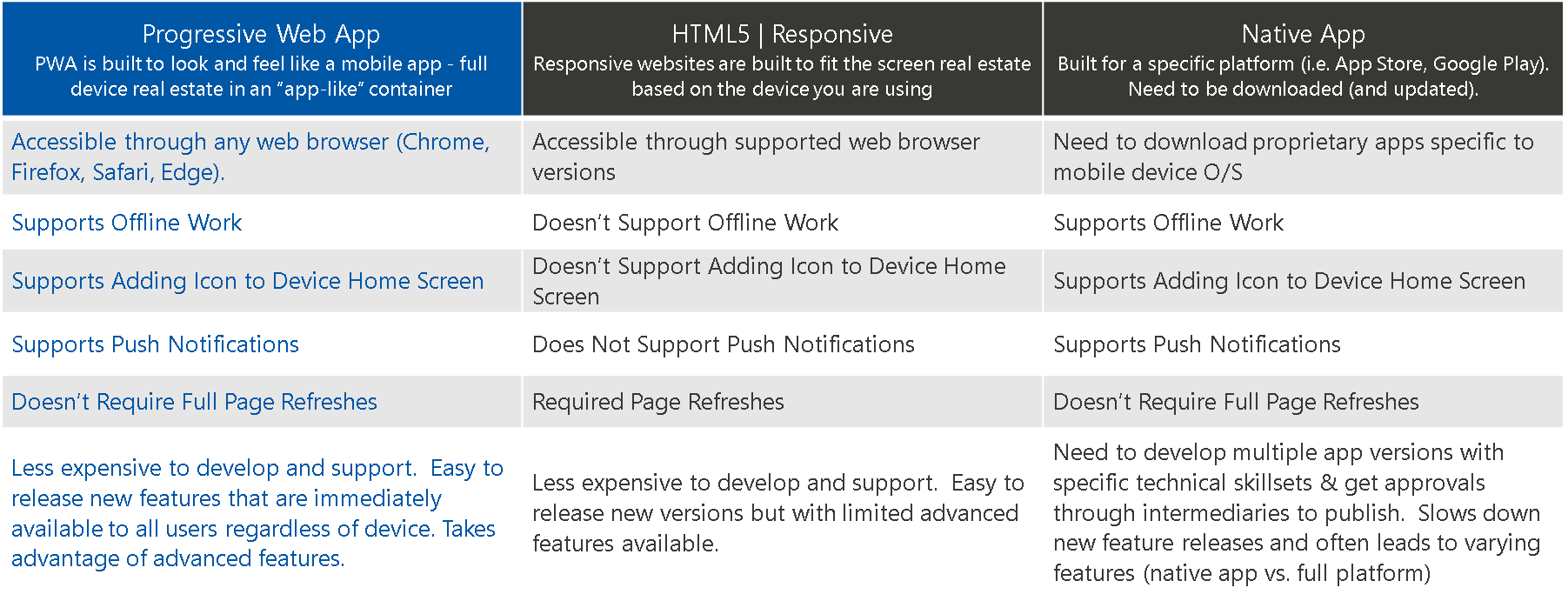
A progressive web app (PWA) is a website that looks and acts like a mobile app, but without limits on functionality or high drop-off rates. PWA build on existing web technology and usually appear as a shortcut on the home screen (no need to download anything or visit an app store).
PWA need no separate bundling or distribution. You publish a PWA just like any other web page. PWA use a newer web technology called “service workers,” which keeps the PWA experience current and responsive and makes offline work possible.

Here are five key benefits of PWA:
What Does This All Mean?
The top challenge companies face worldwide is employee engagement; 85% of employees are either not engaged or actively disengaged at work.[3]
Adoption certainly doesn’t equal engagement, but it is a prerequisite—you can’t have engagement without adoption. Organizations that use PWA gain a significant advantage in connecting all employees on one platform. Strong adoption, combined with the right information and tools (a topic for another post), drives real ROI and helps produce positive business outcomes.
[1] Sources: “Digital in 2018”, We Are Social & Hootsuite; Zenith
[2] Source: Google Web Developer
[3] Sources: . 2017, Gallup State of the Global Workplace, 2015, Deloitte, Global Human Capital Trends
Cary Schuler, SVP Marketing & Product Strategy at Vibe HCM is a business strategist passionate about redefining the way companies leverage technology to maximize the potential of its people. Intent upon transforming workforce applications to recognize and harness the inherently social nature of its people.